
Integrative Therapeutic Formulation is the discipline of creating natural, plant-based formulations that begin with a person and what they need, then reason toward a result that is considered, safe, and well suited to its purpose.
It covers formulations applied to the skin and those made for olfaction, and it works across the full range of natural materials rather than within a single tradition.
It brings together two things that are usually learned apart: an understanding of how natural materials behave and what they offer, both to the skin and to the individual holistically; and the practical skill of building those materials into stable, usable products.
I have spent over twenty years working with natural materials and teaching others to do the same. For most of that time I watched those two halves sit in separate rooms. Essential oils were studied in one place, carrier and vegetable oils in another, hydrolats and plant actives somewhere else again, and the making of an actual product was often treated as a mysterious craft apart from any of them.
A person could know a great deal about a plant and still not know how to build its natural constituents into something that worked on the skin, kept well on a shelf, and suited the person it was meant for.
Integrative Therapeutic Formulation is the name I have long adopted for the work that closes that gap.
Therapeutic formulation, and what “integrative” adds
It is worth being clear about the two terms, because they are related but they are not the same.
Therapeutic formulation is the craft itself: formulating with natural materials for a therapeutic purpose, with the person’s needs in view rather than a market’s. Plenty of skilled practitioners have worked this way for years, quietly and well, each assembling the knowledge for themselves from whatever sources they could find.
Integrative Therapeutic Formulation is what happens when that craft is taken seriously as a discipline and given a structure. The word integrative is doing real work there. It means the materials are brought together rather than kept in separate compartments, essential oils alongside vegetable oils, hydrolats, and plant actives, understood as one connected palette. It means the plant knowledge and the formulation craft are held in the same hand rather than learned apart.
And it means the whole of it is turned toward one question: what does this person actually need, and how do I make it well?
So therapeutic formulation is the work. Integrative Therapeutic Formulation is the discipline that names it, connects it, and gives it a method.
A discipline in its own right
It is tempting to file this work under a heading that already exists, and many have tried, but it does not sit neatly under any of them.
It is not a branch of aromatherapy, though it draws on what aromatherapy understands about aromatic plants.
It is not cosmetic chemistry, though it shares some of its science. It is not herbalism, though it respects the same plant knowledge.
Integrative Therapeutic Formulation is its own discipline because it unites things the others keep separate. It asks the formulator to hold plant knowledge and formulation craft together, and to use both in service of a single question.
Once you treat that as the central question, the materials stop belonging to separate traditions and start to behave as one connected toolkit.
Starting from the Individual
This is the part that matters most, and it is what sets the discipline apart from most other ways of working with plants.
A great deal of plant-based product making starts with the choice materials to be used. Someone has a favourite oil and looks for a way to use it, or they follow a fixed formula and produce the same thing each time. There is nothing wrong with either as a starting point, but neither begins with the person who will use the result.
Integrative Therapeutic Formulation turns that around. It starts with the individual in front of you: their skin, their concern, their preferences and sensitivities, the realities of how and when they will use the product.
From there the formulator reasons toward a formulation, choosing each material because it earns its place, not because it was in the recipe. A therapeutic formulator can tell you why every ingredient is present and what it is doing there.
That reasoning is the discipline, and it is one we explore in its own right in Therapeutic Formulation: Crafted for the Individual.
Working with the whole plant palette
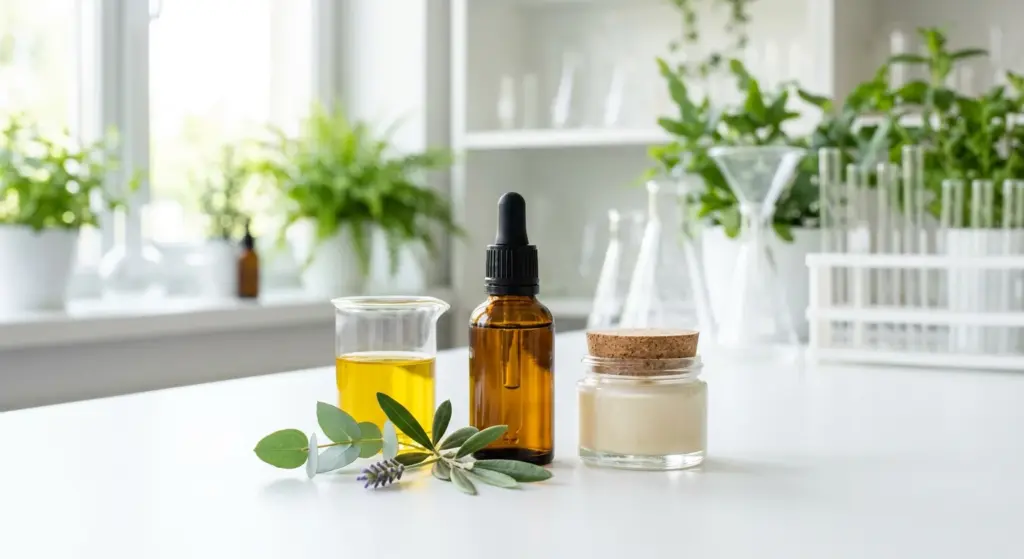
Because the question is always “what does this person need”, the formulator cannot afford to specialise in only one kind of material. The discipline works across the whole plant palette and treats it as a connected whole:
- Essential oils, understood for their properties and used with care and appropriate dilution. The science of the oils themselves is a field in its own right, which we cover in our explanation of aromatology, and the individual oils are profiled in our essential oils guide.
- Vegetable and carrier oils, which carry far more value than the word “carrier” suggests; each has its own character on the skin, as our guide to carrier oils sets out.
- Hydrolats, the water-based companions to essential oils, often overlooked and yet frequently more useful, and covered in our dedicated hydrolats guide.
- Plant extracts and actives, which often bring focused function to a formulation, explained in our guide to plant actives.
The skill is not in knowing these materials in isolation. It is in understanding how they behave alongside one another, and how to combine them into something stable, pleasant to use, and suited to the person it was made for.
A formulation is a set of relationships, not a list of ingredients.
How it differs from related crafts
It helps to place Integrative Therapeutic Formulation next to the fields it is often confused with, not to set it above them but to be clear about what it is.
Cosmetic formulation optimises a product. The brief comes from a market or a brand, and the work is to make something that performs, sells, and meets the specification. Its natural, skincare-focused form, natural skincare formulation, works the same way. Integrative Therapeutic Formulation optimises for a person. The brief comes from an individual and their needs, and the work is to make something considered for them. The science overlaps; the starting point does not.
Herbalism works deeply with the medicinal properties of plants, often through internal preparations. Integrative Therapeutic Formulation works externally, with formulations applied to the skin or for olfaction, and does not extend into internal use. It respects herbal knowledge without claiming it.
Recipe-based product making follows a tested formula to a reliable result, which has real value. This discipline asks you to understand and design rather than only follow, so that when the person in front of you does not fit the recipe, you know what to change and why, beyond the tweaking of the essential oil fragrance.
What a therapeutic formulator does
In practice, the work moves through a recognisable shape, whatever the specific product.
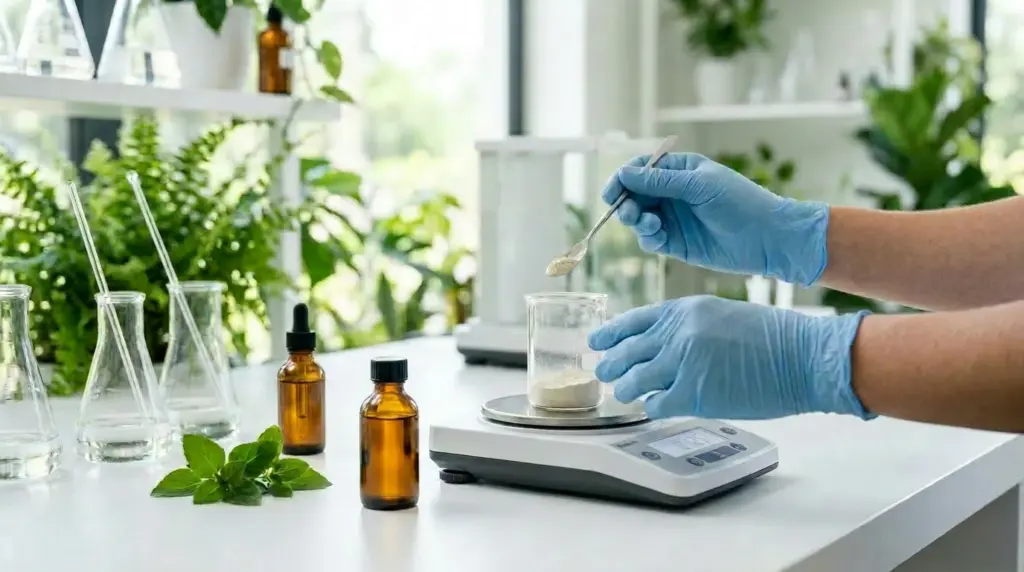
It begins with understanding the person and arriving at a clear sense of what is needed. From there the formulator selects materials with reasoning behind every choice, then designs and makes a formulation that is stable and safe to use.
Good practice means keeping a Client Formulation Plan so the work can be repeated and refined, and keeping safety and suitability in view throughout, from sensible dilution to honest expectations about what a formulation can and cannot do.
None of this is guesswork dressed up, and none of it is following instructions without understanding them. It is reasoned, considered work, which is exactly why it can be taught properly and learned well.
Who it is for
It suits practitioners who already work with people, therapists, complementary and holistic practitioners, and health professionals, who want to bring more depth and structure to their work with natural materials.
It suits experienced formulators drawn to the therapeutic side of the craft, and serious independent learners who would rather understand the reasoning behind a formulation than follow one.
We look at what the move into this work involves in How to Become a Therapeutic Formulator, and at how it extends specific kinds of practice in our writing for practitioners from adjacent fields.
You do not need to come from any single background to learn it. What connects the people it is for is a wish to work with natural materials thoughtfully, and to understand why each choice is made.
Why it deserves its own name
For a long time, I have witnessed this way of working in pieces, carried by individual practitioners who learned to join the dots for themselves.
Naming it as a discipline, and giving it a clear structure, lets it be taught in a connected way rather than reassembled by each person from scratch. It also gives the work the standing it has earned: a serious craft, practised by serious people, with its own principles and its own reasoned approach.
That is the case for treating Integrative Therapeutic Formulation as a discipline in its own right. Not a rebranding of something older, and not a niche within someone else’s field, but a clear way of working that deserves to be understood on its own terms.
Learning Integrative Therapeutic Formulation
This is the discipline I have spent my career practising, and it is the one I now teach at Purodem, through a structured approach to learning the craft from the ground up. It brings the whole plant palette and the formulation skill together, and it keeps the person at the centre throughout.
You can find out more about learning this discipline on the Integrative Therapeutic Formulation course page.
FAQs
-
Is Integrative Therapeutic Formulation the same as aromatherapy?
No, though it draws on what aromatherapy understands about aromatic plants. Aromatherapy is built around essential oils. Integrative Therapeutic Formulation is built around the person, and it works across the whole plant palette, essential oils, vegetable oils, hydrolats, and plant actives, choosing from all of them to suit what a particular person needs.
-
Is it a medical or clinical qualification?
No. It is a non-medical formulation discipline. A therapeutic formulator supports a person’s wellbeing through considered, well-made products; the work is about the formulation, not about diagnosing or treating any condition. That boundary is taught explicitly and is central to how the discipline is practised.
-
Do you treat or prescribe for health conditions?
No. Integrative Therapeutic Formulation supports the person rather than addressing a condition, and it does not involve prescribing or medical claims. It is also formulation-only rather than hands-on: the work is consultation and a formulated product, not a treatment session.
-
Who is it for?
Practitioners who already work with people, such as therapists and complementary, holistic, and health professionals, who want more depth and structure in their work with plant materials; experienced formulators drawn to the therapeutic side of the craft; and serious independent learners. No single background is required.
-
How is it different from natural skincare or cosmetic formulation?
Cosmetic and skincare formulation start from the product, made to a brief for a market. Integrative Therapeutic Formulation starts from the person, made for an individual and their needs. The underlying craft is shared; the starting point is what differs.
-
Who created Integrative Therapeutic Formulation?
It was created by Deana Kassim, Founder and Lead Educator at Purodem, drawn from over twenty years of working with plant materials and teaching formulation. You can read more on her author page.
-
Is it a recognised qualification?
Purodem teaches Integrative Therapeutic Formulation as an independently developed framework: the Level 3 Foundation Award in Integrative Therapeutic Formulation and the Level 4 Diploma in Integrative Therapeutic Formulation, with a Level 5 Advanced Diploma in development. Both qualifications are designed so that graduates can obtain appropriate professional insurance to practise. You can find full details of the qualifications and how to enrol on the Integrative Therapeutic Formulation course page.